
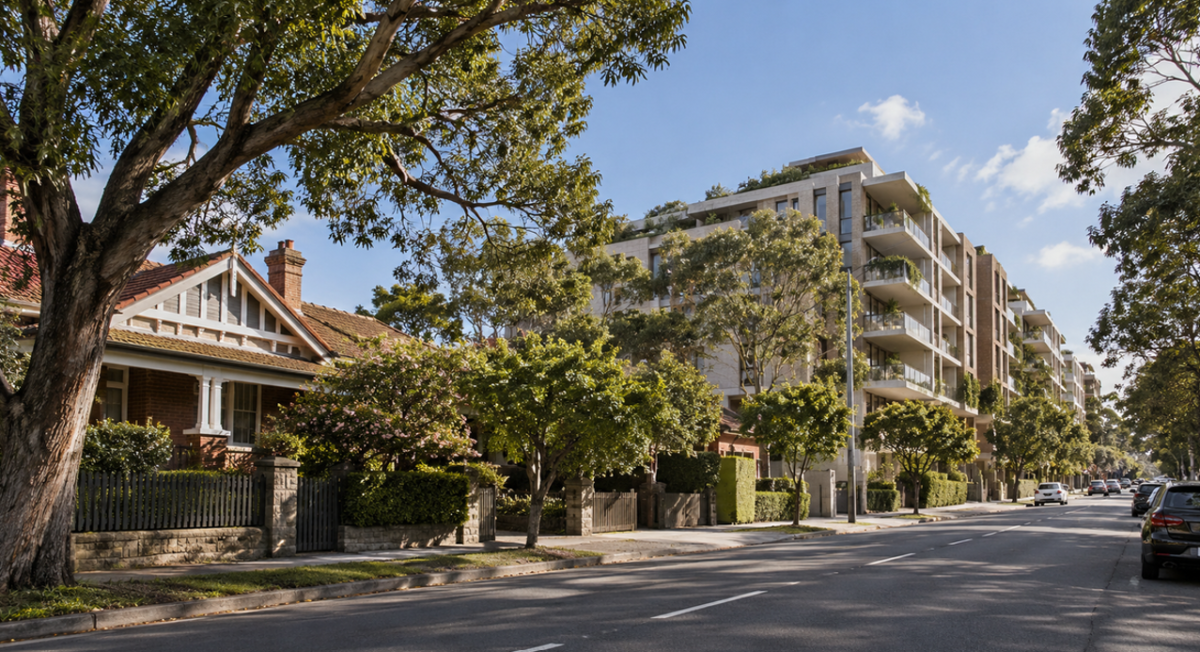
Roseville residents have renewed their push against a major Lord Street apartment development, more than two months after the nine-storey project was given the green light.
The development returned to the spotlight at Ku-ring-gai Council’s public forum on 11 August, where residents urged Council to challenge the NSW Government’s approval of the project at 16–24 Lord Street and 21–27 Roseville Avenue.
Their intervention comes after the State Significant Development was approved on 31 May, clearing the way for 252 apartments across four buildings rising to nine storeys.
Fifty-five apartments are designated as affordable housing. The plans also include three levels of basement parking, landscaping and communal rooftop areas.
For residents who spent months opposing the proposal, however, the approval has not settled the argument.
Residents Return to Council
The concerns raised around the project have ranged from its height and bulk to traffic, parking, tree loss and the effect on the character and heritage of surrounding streets.
Hundreds of submissions were lodged during the State assessment process, and the plans changed along the way.
An earlier version proposed 259 apartments, including 48 affordable homes. The approved scheme has 252 apartments, with the affordable component increased to 55. Setbacks and elements of the building design were also revised.
The Department ultimately determined that the development could proceed subject to conditions.
Now attention has shifted to what happens after that decision.
Residents used the 11 August forum to press Council to take further action against the approval. The public forum itself, however, did not amount to a Council decision to launch a legal challenge.
Lord Street Has Seen Change Before
The argument over what belongs on this part of Lord Street has an added dimension in Roseville.
The suburb began changing rapidly after the North Shore railway arrived in 1890, opening up what had been a much more sparsely settled district to suburban development.
Lord Street carries remnants of that period.
The Lord Street/Bancroft Avenue Heritage Conservation Area includes an intact section of the Clanville Estate subdivision dating from 1903. Heritage records identify its collection of Federation-era houses as an important part of the area’s character.
In a sense, the railway is again helping drive change.
More than a century after rail access helped turn Roseville into a residential suburb, proximity to the station is now part of a broader push for substantially more housing around Sydney’s transport corridors.
The Lord Street project has landed squarely at the intersection of those two versions of Roseville.
A Complicated Planning Backdrop
The development was also being assessed while the planning rules around Roseville were undergoing wider change.
Ku-ring-gai had pursued an alternative approach to increased housing around Roseville and other railway stations as part of its response to the NSW Government’s Transport Oriented Development program.
That broader planning debate was running alongside the Lord Street application, which followed a separate State Significant Development pathway.
For residents arguing that new housing should be distributed differently around the station precinct, Lord Street became an obvious point of contention: a large apartment project proposed beside streets that remain overwhelmingly low-rise.
Metro Concerns Added Another Layer
The debate also went underground.
Because the site is close to Sydney Metro infrastructure, the proposal was examined for its potential effect on the rail corridor.
Sydney Metro advised that the development could adversely affect the operation and safety of its infrastructure unless specified conditions were imposed. It supplied recommended conditions to be included if development consent was granted.
The issue subsequently reached NSW Parliament.
The distinction is important. Sydney Metro did not say the development could not proceed. Its position was that conditions were required to protect Metro infrastructure, and the project ultimately received approval subject to conditions.
From Approval to What Comes Next
Planning consent does not mean excavators immediately arrive on Lord Street.
Major projects can still face post-approval requirements and other steps before demolition and construction begin. No construction start date is established by the May approval itself.
For Roseville, that leaves the project in an unusual position.
On paper, one of the largest developments proposed for this pocket of the suburb has crossed its biggest planning hurdle. On the ground, Lord Street remains largely unchanged — and, as the 11 August public forum showed, the local argument surrounding its future is still very much alive.
Published 14-August-2026